Somehow, 2018 has come to a close. Over the course of last year, our team of six book editors managed to read nearly three million words from our clients! Despite all of that time delving into our clients’ novels, we managed to squeeze in a few more words during our free hours. (We know we’re addicted to reading!)
We’ve put together a list of the best fiction novels we read this year—and we want to make a very clear disclaimer here that none of the books on this list were written by Invisible Ink clients.
Below, you’ll find a list of 2018 book recommendations from our editing team, along with a brief synopsis, a review of why we loved it, and what we think our clients might be able to learn if they read it themselves. That’s not to say that every book here was released in 2018; rather, these are the books we happened to pick up between January and December.
So without further ado…
The best books of 2018 | fiction
The Power, by Naomi Alderman
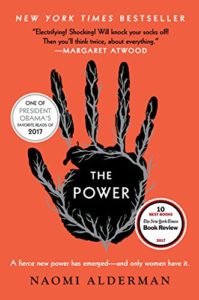 Summary: The Power chronicles an enormous shift in the balance of power on planet Earth, when almost all women simultaneously gain the ability to deliver massive shocks of electricity simply through touch. Suddenly, women are easily able to overpower men, and the tables turn on everyone from sex-traffickers to sultans. The book follows four primary characters during this moment: Eve, a rising religious figure; Roxy, the daughter of a British mob boss; Margot, an aspiring American politician; and Tunde, a sly male journalist watching events unfold through his camera lens.
Why aspiring writers should read it: We frequently remind our clients of the importance of transporting readers to a different world. Alderman is a master of this difficult practice, because she is a master of subtlety. While the changes happening in the world are incredibly explosive, Alderman gives the reader even more hints about the changes in the world through small bits of dialogue and interaction.
Amazon | Goodreads | Author Page
The Cabin at the End of the World, by Paul Tremblay
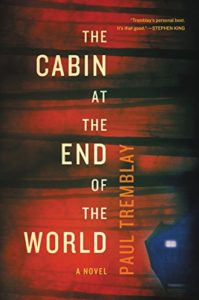 Summary: If there is anything more terrifying than renting a run-down cabin for your vacation, it’s having that vacation interrupted by four people, armed with rudimentary weapons, claiming that the end of the world is coming. This is the basic premise for Tremblay’s harrowing horror novel, which Stephen King himself called terrifying. Andrew and Eric, along with their adopted young daughter, Wren, are vacationing in the titular cabin in a remote part of New Hampshire’s White Mountains when this exact scenario plays out. With no wireless signal and the phone lines cut, the family has no way of knowing whether the four strangers terrorizing their vacation home are a group of crazed cultists or actual harbingers of the apocalypse.
Paul Tremblay’s new one, THE CABIN AT THE END OF THE WORLD, comes out in June. You should mark it on your calendar, it’s that good. Thought-provoking and terrifying.
— Stephen King (@StephenKing) January 16, 2018
Why aspiring writers should read it: The entire novel contains only one setting (the cabin) and seven characters (three family members and four intruders). Tremblay’s novel is extremely restrictive, and yet every character in the book feels realistic and unique. The setting itself is wonderfully described, so much so that the reader also feels trapped in the cabin of horrors. If you are working with such restrictions, or you simply want to know what a fantastic modern horror story looks like, this one is for you.
Amazon | Goodreads | Author Page
Ella Minnow Pea, by Mark Dunn
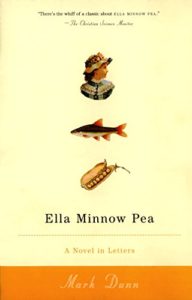 Summary: This novel, told entirely through letters written by various characters, takes place on the fictitious island of Nollop, off the coast of South Carolina. The residents of Nollop revere their namesake, Nevin Nollop, the creator of the pangram (a sentence that contains every letter of the alphabet). A statue in the center of town features his well-known pangram: “The quick brown fox jumps over the lazy dog.” When letters on the statue begin to fall off, the quietly tyrannical leaders of the town determine that those fallen letters should be banned. As you read the novel, the letters that make up the book’s text begin to vanish, and the characters have to come up with more and more creative ways to use their diminished alphabet. The novel is not only an excellent example of constrained writing, but also a fascinating tale of small-town dogma run amok.
Why aspiring writers should read it: If you want to try your hand at constrained writing, Dunn’s novel expertly demonstrates how it can be done. Even without the vanishing alphabet, the fact that he’s written a novel using only correspondences will give you a good idea of how you can break away from traditional formats while still telling a compelling story.
Tomorrow, When the War Began, by John Marsden
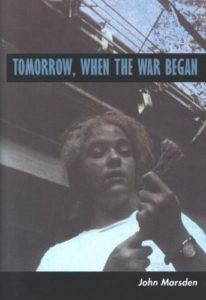 Summary: Though Liam, our chief editor, is an American by birth, he’s been living in Australia for five years now. He’s still learning new things about the sometimes strange and usually beautiful culture there, and this book was a part of that effort. Tomorrow, When the War Began is the book that most high school students in Australia read, and lucky for them, it’s a good one. It’s the first book in a series about a group of Australian teens living through an unexpected war on their home soil. They happen to be out camping in the bush (aka rural wilderness) when an unnamed country invades. The group soon begins to fight back, staging guerrilla warfare efforts against their invaders—and they experience all of the consequences that come with that sort of violence and fear.
Why aspiring writers should read it: Many of our clients dabble in young adult literature, and while it may seem as though it should be easier to target a younger audience, it’s not so easy to write for teens without coming off as condescending. Marsden does a fantastic job of portraying teenagers in a sophisticated, non-stereotypical way, giving them very unique personalities. The main character, Ellie, who tells the story via her journal entries, is incredibly intelligent, but still has some of the insecurities that come with being a teenager. In short, this is a great novel to read if you want to know how to write well for a more youthful readership.
Amazon | Goodreads | Author Page
Autonomous, by Annalee Newitz
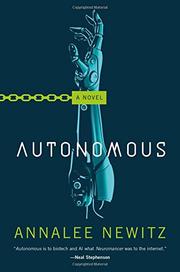 Summary: Jack is a patent pirate living a submarine, reverse engineering medications and doling them out to the general population as a strange rendition of Robin Hood. Eliasz is a young, hotheaded military agent trying to track down Jack after one of her reverse-engineered drugs, known as Zacuity, causes its users to literally work themselves to death. Each of these two protagonists travels with unique companions: on Jack’s team is ThreeZed, a former indentured servant turned rebel; Eliasz travels with a military robot named Paladin who is slowly, excruciatingly learning about the book’s central theme—autonomy. In and amongst this, Newitz brings her readers through a world ravaged by climate change, where most people live in the far north or under enormous air-conditioned domes. The line between human and robot is extremely blurred, and Autonomous also takes us on an in-depth exploration of such complex subjects as gender, free will, and capitalism.
Why aspiring writers should read it: Newitz juggles four main characters in one novel, with a large cast of supporting characters, and yet each of them feels unique, authentic, and likeable. She even gives us their backstories piece by piece through the novel, without hitting the reader over the head with exposition. If your novel has a large cast, this book could be a great inspiration.
Amazon | Goodreads | Author Page
Ill Will, by Dan Chaon
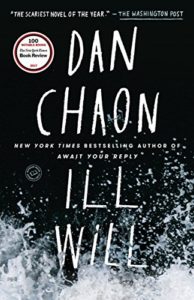 Summary: College-aged boys in midwestern towns keep washing up in lakes and rivers. Is collegiate binge drinking to blame, or something more sinister? Ill Will explores two crimes: these modern-day drownings, and a quadruple homicide decades ago that orphaned our protagonist, Dustin. Now as an adult, Dustin is coping with (among other things), the recent death of his wife, the alienation of his two sons, and a creepy patient who is obsessed with the drownings. The Washington Post called Ill Will the scariest novel of the year (apparently they didn’t read Cabin at the End of the World). While it does have plenty of horror to go around, there is also a deep, unrelenting sadness that hangs heavy over Chaon’s beautiful language.
Why aspiring writers should read it: This is the closest we get to a mystery novel on our list, but it’s a compelling one. Writers can learn from the way Chaon drip-feeds information and uses his multiple unreliable narrators to make the reader question their own sanity.
Amazon | Goodreads | Author Page
Borne, by Jeff Vandermeer
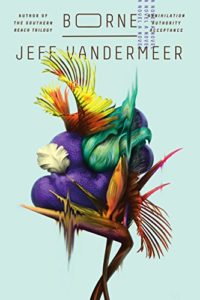 Summary: Where to begin with Jeff Vandermeer’s incredibly strange and evocative novel, Borne? This is by far the most peculiar book Liam read this year, thanks primarily to the novel’s setting and premise. The book takes place years after a massive destructive force has changed Earth into a low-population wasteland, but it’s not like any post-apocalyptic world we’ve encountered before in in fiction. Vandermeer’s world is populated by such things as alcoholic sardines, children with giant wings, enormous and destructive flying bears, and the books titular creature, Borne, which is… well, you need to read the book to truly understand. Borne is a sentient creature, certainly, but it has an amorphous shape and seems to prefer its sense of taste over all other senses. Early in the novel, the protagonist, a scavenger named Rachel, finds Borne and develops an unsettling mother/child relationship with him. As time goes on, Rachel discovers disturbing aspects of Borne’s behavior, but her obsession leads them both down a very dark path.
Why aspiring writers should read it: Writing strong description isn’t easy, and it’s especially difficult when you have creatures and settings that are truly out-of-this-world. Vandermeer rises to the challenge, and any aspiring writer could learn a thing or two about how to describe the indescribable by reading this book.
Amazon | Goodreads | Author Page
Kindred, by Octavia Butler
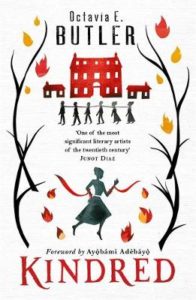 Summary: In Kindred, Dana, a black woman living in California in the 1970s, suddenly finds herself transported back in time to a plantation in pre-Civil War Maryland. She is only there briefly—long enough to save a little boy from drowning in a river—before she is pulled back to her current day. Then, only a few hours later, she is pulled back in time again, to save the same boy, who is now several years older. This happens again and again, until Dana is spending more time living as a slave on a plantation than as a successful writer in California. She endures intense horrors while working as a slave, and though the book is forty years old, it’s a powerful read given the current political climate. Though it’s a departure from the tentacles and vampires that typically feature in Butler’s incredible novels, it still has her signature straightforward storytelling and characters that make your heart ache.
Why aspiring writers should read it: If you want to write good Sci-Fi, then you need to read good Sci-Fi—which means you should rent, buy, or download every word written by Octavia Butler. Kindred is her highest-praised novel, and for good reason. This novel can teach you a lot—how to write historical fiction with accuracy, how to convey the first person effectively, and how to create loveable characters and put them through hell (which is an important and painful skill to learn if you want to master horror).
Amazon | Goodreads | Author Page
Less, by Andrew Sean Greer
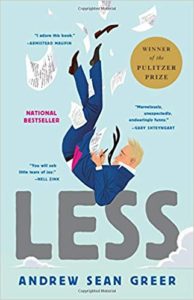 Summary: Less is a satirical comedy-romance about a gay writer, Arthur Less, who sets out on a frivolous literary world tour, mostly as an excuse to skip the wedding of his ex-partner. Arthur Less is in the midst of turmoil as his fiftieth birthday approaches and as he tries to come to terms with his failed love life and mediocre writing career. Part mid-life coming-of-age story, part travel fiction, Less is a unique book that paints relationships, love, and loss with a masterful hand.
Why aspiring writers should read it: In addition to being a New York Times bestseller and Notable Book of 2017, Less won the 2018 Pulitzer Prize as well as the Northern California Book Award. For anyone who wants to write a great novel, it only make sense to read books that earned such top honors. As Ursula le Guin once said, “It was Borges and Calvino who made me think, ‘Hey, look at what they’re doing! Can I do that?’” Less does a few things extremely well. It breathes life into a remarkably lovable character, it stays light and funny while dealing with themes of depression and heartbreak, and most of all, it plays with a reflective structure that frames the narrative while it also deepens the characterization of Arthur Less and all the people he cares about.
Amazon | Goodreads | Author Page
2312, by Kim Stanley Robinson
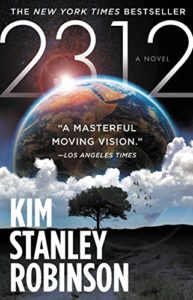 Summary: It’s 2312. Mercury, Venus, Mars, and even the insides of cored-out asteroids have been transformed into incredible terraformed habitats. Swan Hong, an artist and expert terrarium designer, is pulled into a conspiracy that seems to pit the inhabitants of Earth against everyone living in space. After the Mercury colony is nearly destroyed, Swan must disentangle a mystery that threatens to jeopardize the stability of the entire solar system.
Why aspiring writers should read it: 2312 won the Nebula Award for best novel. That’s not to say every Nebula winner is solid gold. We have definitely come across some titles in this list that aren’t exactly mind-blowing (Ancillary Justice, ahem). However, 2312 stands out for a number of reasons. First of all, the book is full of interesting characters, breathtaking worlds, and sentence-level poetry. But perhaps more than that, every aspect of the near-future seems to have been considered, in terms of technology, bio-engineering, terraforming, as well as humanity’s social evolution. Through characters with physical modifications and extended age, Robinson explores ideas around the personal, interpersonal, and social impacts of enhanced longevity. Many “high concept” science fiction novels focus on one aspect of future tech and its implications for our descendants. In contrast, 2312 offers such a scope of future possibilities, it reads like a prescient glimpse into the next era for humanity.
 There are a couple things that might be said about setting book launch dates. First, when setting such a date, it makes sense to think like a traditional publisher. But, second, as an indie, you should also not be afraid to think like yourself.
Here’s what I mean. There are many resources both online and otherwise on setting a timeline for a book launch that looks at what large publishers do. One of the first considerations might be whether you want to have your book launch tied in to a particular window or season within the retail calendar.
For example, a lot of books are sold in November and December during the year-end holidays. So a book might have to be released by Halloween so that there is buzz leading into this busy buying season. Or some books might tie in to summer beach reading, or a self-help book might tie in to January sales as readers attend to their New Year resolutions. Consulting editor Alan Rinzler has a
There are a couple things that might be said about setting book launch dates. First, when setting such a date, it makes sense to think like a traditional publisher. But, second, as an indie, you should also not be afraid to think like yourself.
Here’s what I mean. There are many resources both online and otherwise on setting a timeline for a book launch that looks at what large publishers do. One of the first considerations might be whether you want to have your book launch tied in to a particular window or season within the retail calendar.
For example, a lot of books are sold in November and December during the year-end holidays. So a book might have to be released by Halloween so that there is buzz leading into this busy buying season. Or some books might tie in to summer beach reading, or a self-help book might tie in to January sales as readers attend to their New Year resolutions. Consulting editor Alan Rinzler has a