When you finish the first draft of your novel, it’s easy to start daydreaming about book covers and release parties.
But, before you can cross the finish line, you’ve got to go through the editing process. You may think the next step is to hire a book editor, but before you spend money on a professional, there’s another step you must take: beta reading.
Beta readers are volunteers who will review your manuscript and offer high-level feedback to help shape your next draft and get it ready for a professional editor. After spending months, if not years, working on your novel, you’ve become intimately familiar with your characters, plot, and other story elements.
But when you’re that familiar with your work, it can be much more difficult to pick up on things like plot holes, repetitive phrasing, shallow characters, and other potential issues. A fresh set (or several sets) eyes can provide you with a different perspective, bring to attention obvious or subtle things you’d maybe want to change, and generally just give you an idea of how others will perceive your book.
In this blog, we’ll explain how beta reading works and show you exactly where you can find your ideal reader.
What is a beta reader?
Beta readers are people who read your novel (or parts of it) and give you their feedback and opinions.
Beta readers are usually avid readers, but they are not professional book editors. They act similarly to a focus group: a sample of your ideal reading demographic, giving you an idea of any issues you may want to address before publishing your book.
Sometimes beta readers are people you find through writing communities, other times you’ll connect with them through paid services. We get into all of that later in this article, but for now, let’s talk about where beta readers fit into the overall editing process.
When do you need a beta reader?
Beta readers are most useful once you have a complete manuscript—or at least a complete draft—that you’ve already revised on your own at least once. If you’re still writing, that’s a job for an alpha reader—someone who reads your work in progress and gives you early feedback as you go. Beta readers come later, once there’s a moderately polished full draft to evaluate from start to finish.
But you can’t just type ‘the end’ and hand it over. Giving a rough first draft to a beta reader is a bit like asking someone to critique a half-built house. The structural problems you already know about will distract from the feedback you actually need. So it’s important to revise your manuscript and address any known issues first.
Related: How to edit your own novel
If you’re not sure your manuscript is ready for beta readers, a manuscript evaluation might be a better first step. A professional editor will read your work and give you a high-level assessment of what’s working, what needs attention, and what to tackle in your next revision. Once you’ve addressed those bigger issues, you’ll get much more useful feedback from your beta readers.
If you’re earlier in the process—still drafting, or having issues with structure—book coaching might be the right fit. A book coach works with you throughout the writing process, helping you avoid major problems before they take root, and can help you figure out when it’s time to bring in outside readers.
Why do you need beta readers?
As we mentioned earlier, beta readers provide new perspectives to consider as you head into your second draft. You give the manuscript to a handful of people who enjoy or are familiar with the genre. They tell you what they liked and didn’t like, whether the ending left them satisfied, whether the characters were believable, what they wish would have happened, what they were confused about… the list goes on and on.
Beta readers can give you a glimpse into how the average reader will receive your book, highlighting any issues you may want to address with the plot or the characters or the narrative voice (or anything else, for that matter). They see things you cannot because they are not inside your head and don’t read the intentions of what you wrote but simply ingest the words you put on the page.
Just because you are trying to convey a certain feeling or idea does not mean the route you took was the most effective or successful. Beta readers can help you pinpoint those problematic areas and see them from a new angle, so you can then adjust and enhance them.
It won’t all be negative feedback, of course. Beta readers can also tell you what parts of your novel they liked the most, and what they want to see more of. They’ll give you feedback on your tone and style, and whether or not it’s working for them. All of this information is incredibly valuable for the next draft of your manuscript.
What do look for in a good beta reader
Before we get into the places you can begin looking for your beta readers, let’s talk about what makes a good beta reader.
First of all, a beta reader cannot be a friend, partner, family member, colleague, or anyone else you have a preexisting relationship with. The purpose of a beta reader is to get honest, direct feedback. Though your friends and family may say they are going to give you their honest opinion, it’s highly unlikely that their feedback will go as deep or be as rounded and honest as someone who doesn’t know you already.
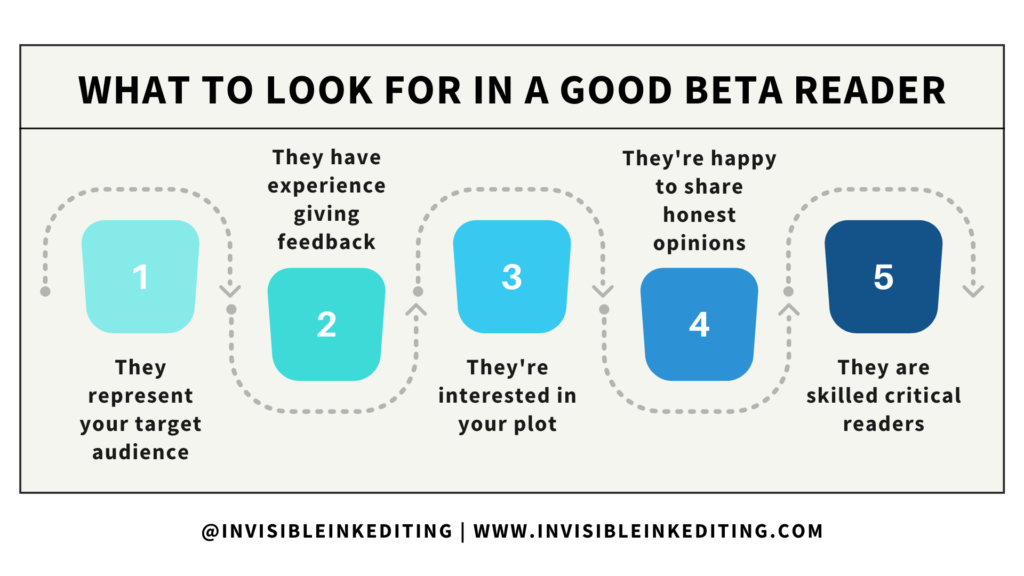
In an ideal world, a beta reader has most, if not all, of the following qualities:
They represent your target audience
Above all else, the beta readers you choose should be representative of your audience as a whole. You’ll see we recommend narrowing your search for beta readers to your specific genre. This will make sure that any feedback you get from them reflects what your larger, future audience will want.
Experience providing writer feedback
When you’re dealing with an experienced beta reader, it will be much easier to get comprehensive, coherent, and honest feedback out of them. If they haven’t acted as a beta reader before, they should at least be an avid reader of your genre.
Interest in your story, specifically
Before you start searching for beta readers, it’s a good idea to have a good synopsis of your story written up already. You want to make sure your beta readers will make it to the last page of your manuscript, and they’re much more likely to do this if they know the basics of your plot ahead of time.
A strong opinion
It will be incredibly frustrating if you spend your time finding a beta reader and trusting them with your manuscript, just to have them come back with vague or wishy-washy feedback. You want to find readers who will share their thoughts clearly, without sugarcoating them or holding back.
A critical eye
Of course, your beta reader needs to be able to read manuscripts critically. You want detailed, thorough feedback—not someone who simply says, “I loved it!” or “It wasn’t as scary as I thought it would be.” Look for people who know how to get into the nitty-gritty of your work.
How do you find a good beta reader for your novel?
Now that you understand the value of beta readers and what to look for, the next logical question is:
Where the heck do you find them?
Beta readers typically are not paid for this work (though some are, and we’ll get to that), and you can’t just pick any random person off the street. So how do you tap into this wealth of feedback and early insights to help you edit your novel and get it ready for a professional book editor?
There are lots of avenues you can pursue. Here are some of the best methods for finding beta readers.
Invisible Ink Editing's book coaching or manuscript evaluation
Before you start hunting for beta readers, it’s worth considering whether your manuscript is ready for them. Beta readers are most valuable when your draft is in solid enough shape to be read from start to finish—which isn’t always the case after a first draft.
If you’re not sure where your manuscript stands, a manuscript evaluation from Invisible Ink Editing might be a better first step. One of our professional editors will read your work and deliver a detailed report covering what’s working, what needs attention, and what to tackle next. You’ll go into your beta reading process with a clearer sense of what feedback you’re seeking, making your beta readers’ input all the more helpful.
If you’re still working on the first or second draft, or if you want ongoing support as you write and revise, book coaching might be the right fit. Your coach works with you from wherever you are in the manuscript — helping you strengthen the structure, develop your voice, and figure out when you’re ready to bring in outside readers. When that time comes, your coach can also help you make sense of the beta feedback you receive and decide what to do with it.
Not sure what your book needs right now? We’re here to help you. Use our submission form to send a sample of your manuscript—even if it’s not complete—and give us some more information about the project. We’ll get back with guidance on the best next step.
Independent Book Review's Group Beta Reading
We know the team at Independent Book Review personally, and we highly recommend their group beta reading service. IBR will pair your manuscript with 3 or 5 professional readers—reviewers, librarians, booksellers, book bloggers, editors, and authors—who deliver 650+ words of feedback per reader within 3 to 6 weeks. Fees range from $429 to $929 depending on the package you choose.
As an added bonus, Invisible Ink clients who sign up for book coaching or manuscript evaluation will receive a $20 discount code from their editor to use toward an IBR beta read.

Substack
Substack has quickly become one of the most active and engaged communities of writers on the internet, making it a very effective place to find beta readers. If you’re already publishing on Substack—or even if you’re just getting started—your subscribers are readers who have actively chosen to follow your work. That’s a built-in pool of people who may be genuinely interested in reading an early draft.
Beyond your own audience, Substack’s Notes feature and its network of writing-focused publications make it easy to connect with other writers and readers in your genre.
Often, subscribing to certain Substacks will put you in a chat room with other readers, and depending on the rules of the Substack, you may be able to ask for beta readers there.
Building a presence on Substack takes time, but the relationships you develop tend to be more invested than what you’d find in a generic forum or Facebook group. If you’re not on Substack yet, it’s worth considering—not just as a tool for finding beta readers, but as a long-term strategy for growing your audience as an author.
Local writing groups and exchanges
The easiest and most affordable way to find beta readers is to explore your own community. There are many online and community groups that help writers build writing groups, and often those writing groups can introduce you to people who are willing to look at your manuscript from start to finish.
The simplest place to start looking for local writing groups is with a Google search, or by visiting your local libraries or community centers. Most big cities have writing centers that offer events, classes, and community groups where you can meet other local writers.
The easiest way to find these groups is to do a simple Google search for writing communities in your area. We are big fans of Grub Street in Boston, the Writer’s Center in DC, Gotham Writer’s Center in New York, the Lighthouse Writing Center, and the 826 Network.
You can also use sites like Meetup, Craigslist or local subreddits to find out if there are any local groups that get together to discuss and share writing. If there isn’t one nearby, maybe you can start your own!
Once you get into these groups, you’ll start sharing your writing and gathering feedback. If you are in a group with people who are at the same stage of writing as you, you can suggest exchanging manuscripts with each other.
Facebook groups
If you’re a Facebook user, then finding beta readers is as easy as logging into the social media platform and running a few searches for writers’ and readers’ groups.
These forums are filled with people who are just as passionate as you about writing, your genre, the subject matter you’re writing about, etc. To help you choose the right group, think about who your ideal readers are, and then search for groups related to that topic.
Let’s say, for instance, you’ve just finished your first draft of your zombie apocalypse thriller. Your first move will probably be to search for fans of zombie books, but you could also look to doomsday prepper groups or just groups for people who love dystopian and post-apocalyptic stories.
When you join these groups, be sure to follow the rules as they are clearly stated. Most groups will have rules about who can post, how often, and in what format (some may allow solicitation of services like beta reading while others may not). So take time to read all of the information on the page, and watch how other people are interacting before you dive in.
Writers forums (including Subreddits)
You can find loads of forums, message boards, and Subreddits dedicated to writing in general as well as by genre. These can be great places to ask for beta readers, but you can’t just create an account, spam the group with requests to read your book, and expect volunteers to come flooding in.
To use these groups properly, you have to participate and have a more established presence. It shows you’re not just there to reap the benefits without offering anything in return, and it is just a good look, professionally speaking. The result is that people will be more willing to help you out.
The fastest way to offer something of value is to offer to read others’ manuscripts and provide your own honest feedback. There is a lot of “you scratch my back, I’ll scratch yours” going on in these groups. Just be sure that if you promise to read something, you follow through—otherwise, you’ll end up developing a bad reputation.
If you’re ready to start looking for beta readers, here are a few places worth exploring:
Beta Readers & Critiques (Facebook)
Critters Speculative Writers Workshop
Indie Author Group (Facebook)
r/betareaders (Reddit)
r/keepwriting (Reddit)
r/writing (Reddit)
Betareader.io is worth a special mention, because it’s an easy way to find and manage your beta readers for relatively no cost—or a very low cost. The service allows you to sign up as a writer, a reader, or both, and once you do, you’ll have access to a database of beta readers who are willing to look over your manuscript.
With the free version, you can submit one manuscript and get up to three readers. You’ll be able to track your beta readers as they go, and they can even leave highlights and emojis to let you know their reactions to certain passages.

The upgraded version is still affordable at only $10 per month, and allows you unlimited manuscripts and readers. If you have the budget, and plan to write more than one novel, this may be a good option for you.
The Spun Yarn takes a data-driven approach to beta reading that sets it apart from most services. Their complete manuscript report matches your book with three carefully selected readers and delivers a 30+ page report within 30 days, covering flash feedback, qualitative feedback, and quantitative scores across eight key categories. Manuscripts must be under 90,000 words for the standard package, which starts at $699. Options are available for longer manuscripts as well.
Should you pay for beta readers? And how much do beta readers cost?
This depends on who you find and what you’re looking for.
If you just want someone to give you their thoughts after reading your book, you can probably find a beta reader to do it at no cost using the methods we mentioned above.
If you have a list of questions you want them to think about as they read, or if they go above and beyond with their feedback, you might want to offer some sort of compensation, even if it’s just a gift card and a hard copy of your book when you publish (sign it for them too, if you can).
Reading a book is no small task, and providing feedback, whether written notes or a conversation afterward, is even more of a commitment. If you want a professional beta reader or professional book editor to work with you, then it makes sense to compensate them for their work.
What should you ask your beta readers?
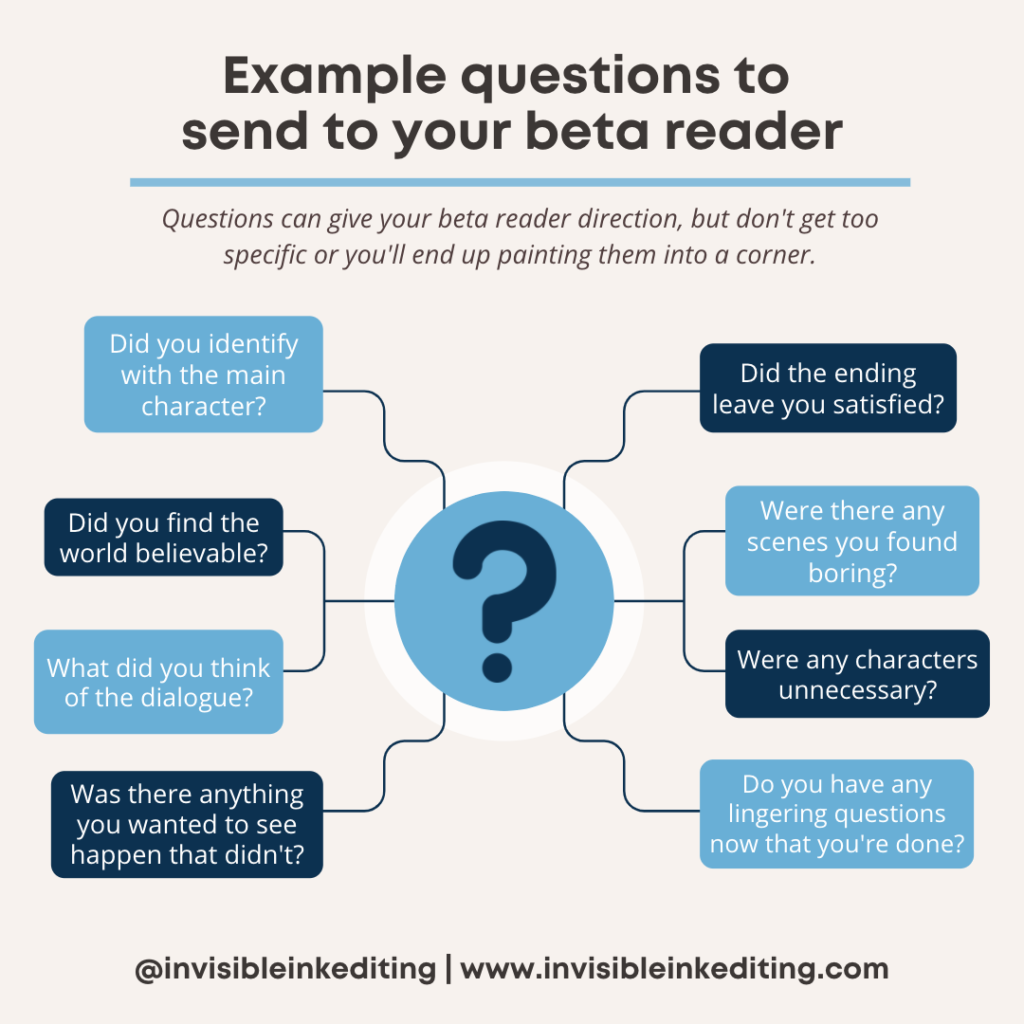
As we mentioned above, giving a beta reader some direction when you hand over your novel is a good idea. However, you don’t want to get too specific, as this can paint them into a corner and narrow their perspective. An expansive, outside perspective is what we’re looking for, so do your best not to limit them.
Instead, give them broader, guiding questions to get the wheels turning.
Here are a few questions you can consider asking:
- Did you like the main character? Why or why not?
- Did you find the world believable?
- Did you find the other characters believable?
- Was there anything you wanted to see happen that didn’t?
- Did the ending leave you satisfied?
- Were there any scenes you found boring?
- Were any scenes unnecessary?
- Do you have any lingering questions now that you’re done?
You have two options when it comes to your list of questions:
- Give them to the beta reader along with the manuscript
- Wait until they’ve read the book and then hand them over.
The former option allows them to focus more closely on these details as they read. The latter gives them a chance to read without anything in particular in mind. They can then look back and assess how they felt about each topic in the moment. This might also reveal that something you saw as important or problematic went unnoticed, or vice versa.
There’s no right or wrong way to go about this, so try each method with different beta readers and/or different manuscripts. You can also leave the choice up to the beta reader. Ask them if they’d like some questions before they read, or if they’d prefer to go in blind.
How many beta readers do you need?
You don’t want too many cooks in the kitchen, but having a few different perspectives creates a more well-rounded look at how your book is being received.
Aim to find at least three beta readers, but no more than five or six. This allows you to see if there are any overlaps in feedback, which is a clear sign you should reevaluate the area of concern. Anything beyond that and you’ll have too much feedback on your hands, which can easily cross the line from helpful to overwhelming.
What to do with beta reader feedback
Once you’ve gotten your beta readers’ feedback, the next step is to read it carefully and determine what you want to change about your manuscript.
As you go through, look for common pieces of feedback—were there any scenes, plotlines, or characters that several people called out, for the same or similar reasons? If so, you’ll definitely want to work this into your manuscript.
Reading feedback is rarely easy, so do your best not to take anything personally. The important thing is to consider the commentary, be it a concern about a particular character or plot point or a suggestion for a different direction. Think about why this may have been the reader’s reaction and how making that change could impact the story, good or bad.
If you’re on the fence about whether you want to take a suggestion, give it a try. Make some changes, and see how you feel about the outcome. You may even want to reach back out to your beta reader and ask them to read a revised scene. If you aren’t satisfied with it, you can always go back to the original, or take the scene in a whole new direction.
You can also ask the beta readers to weigh in on each other’s feedback, anonymously. Let’s say that Beta Reader A tells you that a certain character should come into the story earlier. You aren’t sure, so you ask Beta Readers B and C whether they think that change would be good or not. Their opinion can help you decide what to do.
After you’re happy with the draft, it’s time to find a professional editor. Curious to learn more about that process? We’ve got you covered. You can read more about what goes into hiring the right editor here.
Finished with the beta reading process?
The next step in the editing process is to hire a book editor, and we want to hear from you. Send us a sample of your manuscript below, and if it’s a good fit for our services, you’ll be matched with an editor who will provide a free edit of the first few pages of your work.